Abstract
A few practical improvements this week, mostly driven by what we’re learning as customers deploy CertKit into larger infrastructures.
Copy and share agent configuration
If you’re managing more than a handful of servers, you’ve probably noticed the pattern: your Elasticsearch nodes all have the same certificate config. Your Redis cluster is identical across every node. Your web servers are all doing the same thing. But in CertKit, you had to set each one up individually, and if something changed, you were clicking through dozens of agent forms to make the same edit.
Now you can copy the configuration from any agent in your system to any other agent. You can either keep the configurations linked, so a change to one propagates to all of them, or split them apart when something needs to be different (like a dev environment that points to a different path than production).
This is the kind of thing that doesn’t matter when you have five agents. It matters a lot when you have fifty. And the linked configurations mean you’re not just saving setup time, you’re reducing the surface area for configuration drift across your fleet.
Sorting and searching monitors
Some of you now have dozens or hundreds of monitored domains in CertKit, and the flat list wasn’t cutting it anymore. We added a few ways to organize that view.
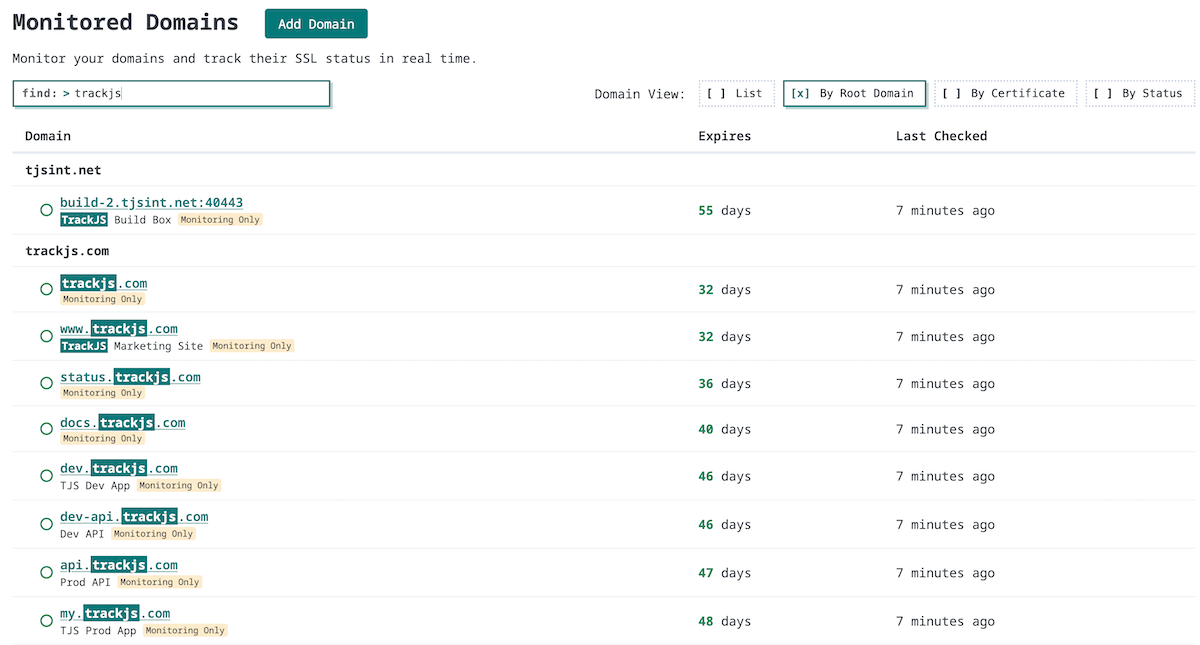
You can now group monitors by root domain, by the certificate they share, or by status. There’s also a free text search so you can find the domain you’re looking for without scrolling through the whole list. Small thing, but it makes the daily workflow noticeably faster once your domain count gets into the double digits.
GDPR Data Processing Agreement
We published our first official Data Processing Agreement for GDPR compliance. The only personal data CertKit processes for you are user names and passwords, and we use that data for exactly what you’d expect: letting you log in. But GDPR requires that we be specific about how we handle that data, where it’s stored, and what rights you have over it.
If your organization needs a DPA on file before adopting a new vendor, you can find ours at certkit.io/dpa.
CertKit automates certificate lifecycle management across your infrastructure. See the full roadmap for what’s coming next.